What is a Fabric Bag Dust Collector? 4 Commonly Used Filter Fabrics
Focus-Engineering
14:02 19/12/2024
Air is one of the most essential conditions for the survival and development of all living organisms on Earth, including humans. However, air pollution has reached alarming levels, especially pollution caused by dust. There are numerous sources of dust generation, with industrial production activities being one of the primary contributors.
So, what are the solutions for dust control? One effective method is using a fabric bag dust collector system. Let’s explore what a fabric bag dust collector is and what types of filter fabrics are commonly used.
Introduction to Fabric Bag Dust Collector System
Definition of Fabric Bag Dust Collector
A fabric bag dust collector, also known as an air filtration system or baghouse filter, is an air pollution control device that removes dust particles from the air or gas emitted during industrial production or fuel combustion. In other words, it is a system consisting of fabric filter bags designed to capture airborne dust, ensuring cleaner air is released into the environment.
Power plants, steel factories, pharmaceutical production facilities, food processing plants, chemical industries, and other industrial companies commonly use baghouse filters to control air pollutant emissions.
Fabric bag dust collectors became widely adopted in the late 1970s after the development of heat-resistant filter fabrics capable of withstanding temperatures above 350°F (177°C).
Unlike electrostatic precipitators, whose efficiency can vary significantly depending on operating conditions and process parameters, fabric bag dust collectors consistently achieve dust collection efficiency of 99% or higher (up to 99.9%), even for fine particles as small as 2.5 µm.
Structure of Fabric Bag Dust Collector System
A fabric bag dust collector consists of one or multiple compartments containing rows of fabric filter bags arranged in cylindrical, flat, pleated, or tubular shapes. Dust-laden air flows along the filter bag surface and penetrates the fabric, while dust particles are trapped on the upstream side of the filter bags, and clean air is discharged.
The system operates in cycles, alternating between relatively long filtration periods and short cleaning cycles. During cleaning, accumulated dust on the filter bag surfaces is dislodged and collected in hoppers for further processing. The fabric filters effectively capture dust particles of varying sizes.
Most baghouse filters use cylindrical or tubular bags made of woven or non-woven fabric as filtering media. For applications with low dust loads and gas temperatures up to 250°F (121°C), pleated filter bags with steel frames are commonly used.
Dust-laden air enters the system through a hopper (a large funnel-shaped component for collecting and dispersing dust particles) and is directed into the filtration chamber. Depending on the cleaning method, airflow can pass through the bag’s inner or outer surface, accumulating a dust layer on the filter surface. Once the pressure drop (ΔP) reaches a specific threshold, the cleaning process begins. Cleaning can occur either during operation (online cleaning) or when the system is isolated (offline cleaning). Once the cleaning cycle is complete, normal filtration resumes.
Working Principle of Fabric Bag Dust Collector
Fabric bag dust collectors are highly effective due to the dust cake that forms on the filter bag surface. Dust is captured through four key mechanisms:
Inertial Impaction – Dust particles collide with fibers that are perpendicular to the airflow instead of following the airflow direction.
Interception – Particles are trapped as they come into contact with filter fibers due to the small gaps between them.
Brownian Motion – Fine particles undergo diffusion, increasing their contact with the filter media and enhancing collection efficiency.
Electrostatic Attraction – The presence of static charges on dust particles and filter fibers enhances dust retention.
The combination of these mechanisms leads to the formation of a dust layer on the filter, which increases airflow resistance. Therefore, periodic cleaning is necessary to maintain system efficiency.
Commonly Used Filter Fabrics
The most commonly used filter fabrics include:
Cotton Fabric – Provides good filtration efficiency at a low cost but lacks chemical and heat resistance, is flammable, and retains high moisture content.
Wool Fabric – Offers high permeability, stable cleanliness, and easy regeneration but has low chemical and heat resistance, is more expensive than cotton, and becomes brittle at high temperatures (operates up to 90°C).
Synthetic Fabric – Has high durability and is increasingly replacing cotton and wool due to its cost-effectiveness. For example, Nylon fabric is used in chemical and metallurgy industries for gas temperatures ranging from 120–130°C.
Fiberglass Fabric – Withstands temperatures of 150–250°C and is commonly used in cement and metallurgy industries. Heavier fabrics (600–800 g/m²) are used for low dust concentrations, while lighter fabrics (400–500 g/m²) are used for high dust concentrations.
Focus Engineering Co., Ltd. – Leading Provider of Advanced Fabric Bag Dust Collector Solutions
With over 20 years of experience, Focus Engineering Co., Ltd. specializes in providing comprehensive dust filtration solutions to help businesses maintain a clean and safe working environment while minimizing environmental pollution.
With an ISO 9001:2015-certified quality management system, a team of highly skilled engineers and technicians, and strong partnerships with globally recognized technology providers such as Martin Engineering (USA), Imeco (Italy), Stif (France), Challenge (UK), and DongYang (South Korea), we are committed to delivering the best-fit solutions to meet all customer and partner requirements.
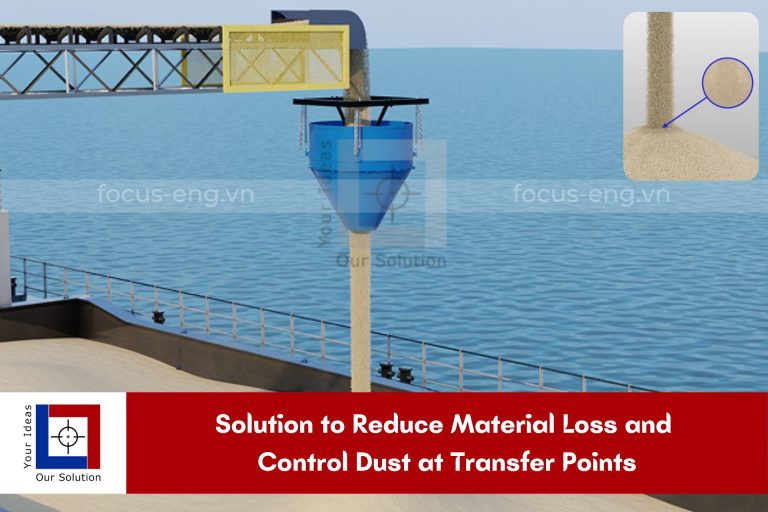
In industrial bulk material handling systems, transfer points are often “black spots” that cause material loss and fine dust emission, directly leading to revenue leakage and driving up equipment maintenance costs. A comprehensive control solution at the source—through the synchronous combination of optimized chute design, multi-layer skirting systems, impact cradles, and modern dust suppression technology—not […]
Nowadays, environmental pollution is no longer just a problem for a single country or region; it has become a global issue. The socio-economic development of nations worldwide has significantly impacted the environment, altering human living conditions and making them increasingly worse. Environmental pollution has caused severe consequences, negatively affecting ecosystems, directly impacting human health, and […]
Our country’s industry is developing rapidly. While this brings significant economic benefits, it also leads to increasing environmental pollution. Industrial zones are releasing alarming amounts of dust and emissions into the atmosphere, severely affecting the quality of human living environments. The direct consequences include negative impacts on workers’ health and mental well-being when exposed to […]