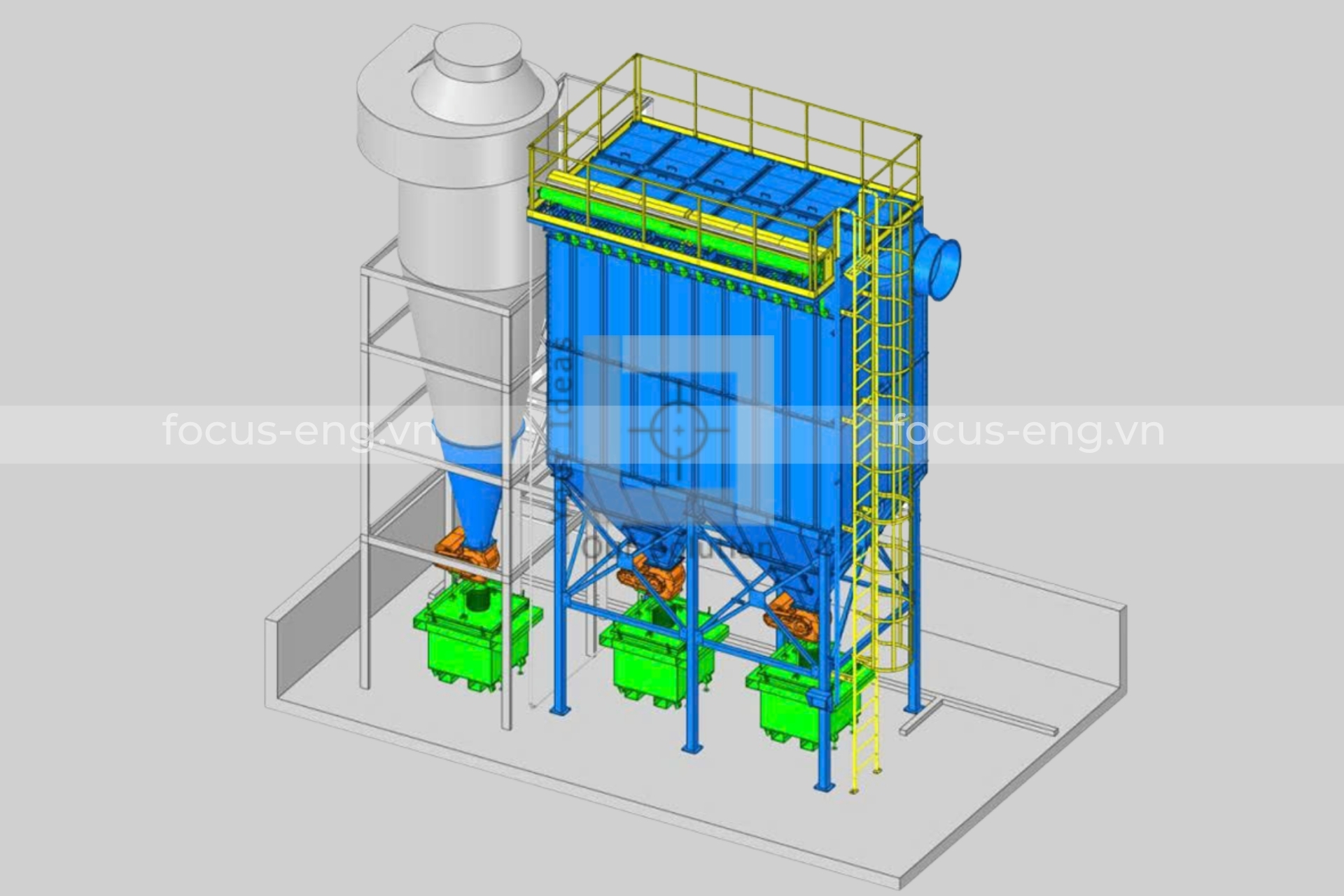
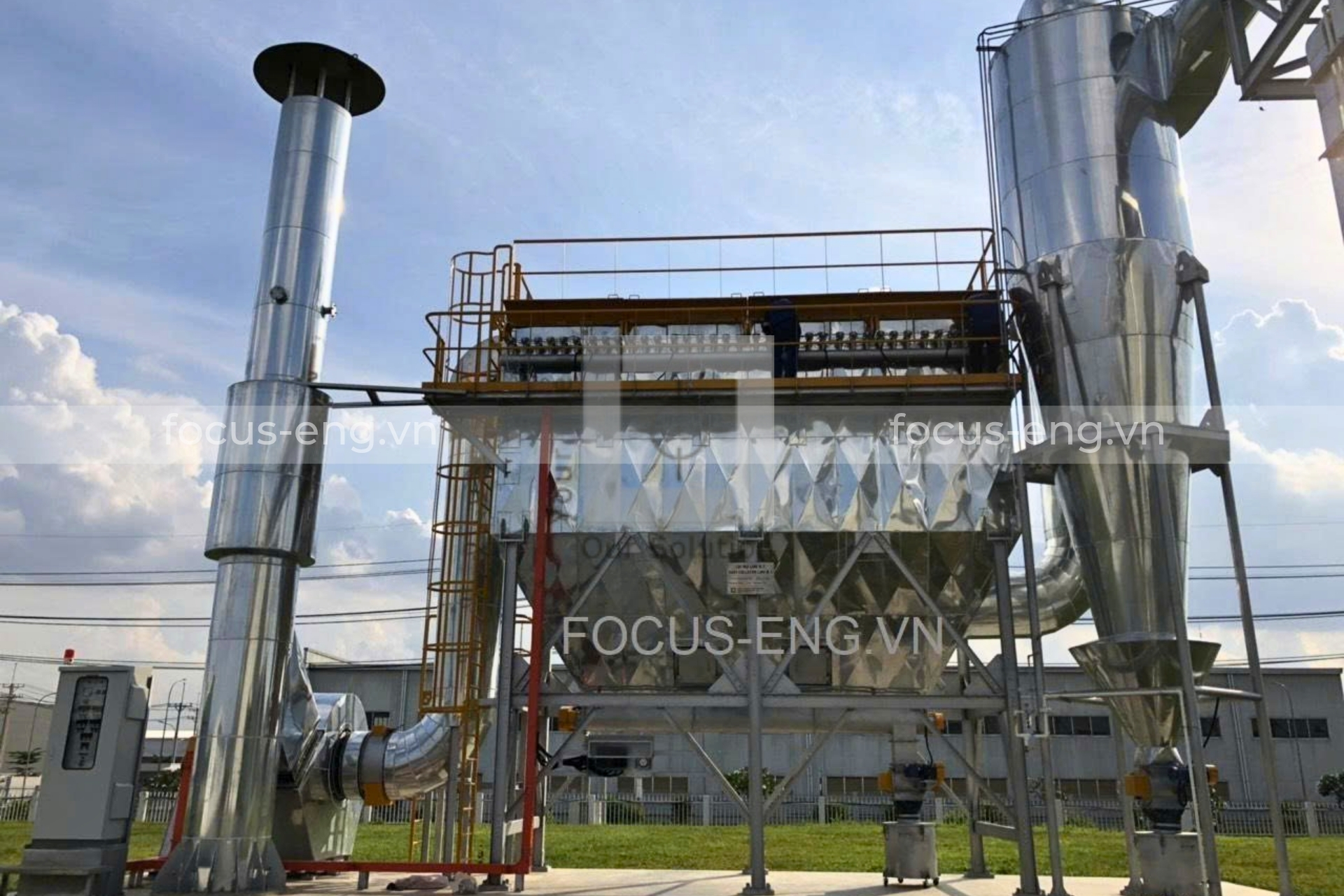
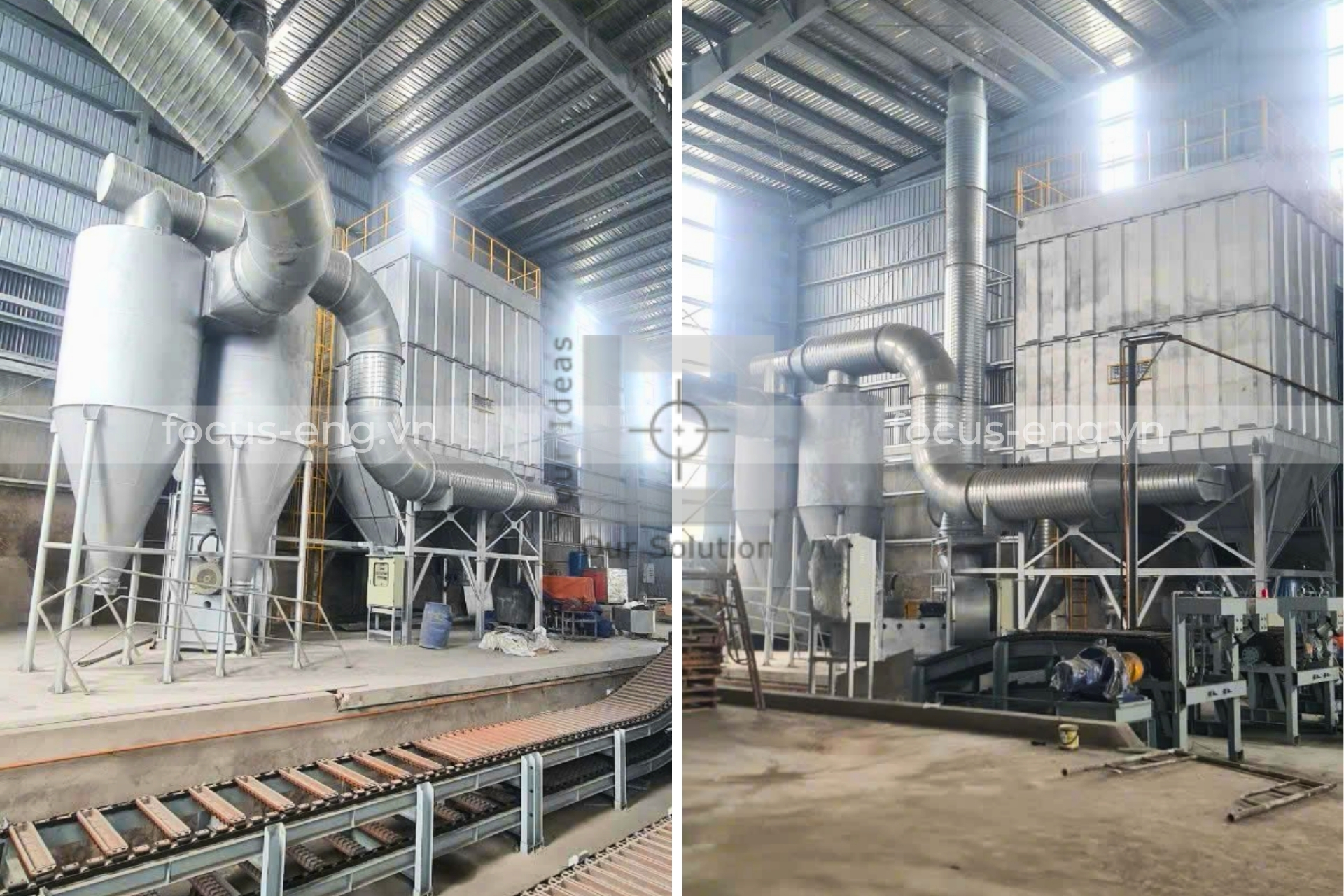
Overview of the Two-Stage Dust Collection System (Cyclone + Bag Filter)
focuseng
16:38 07/11/2025
1. Operating Principle of the Two-Stage Dust Collection System
The two-stage dust collection system is designed based on the principle of processing dust from coarse to fine, aiming to achieve optimal filtration efficiency and meet QCVN emission standards.
Stage 1 – Cyclone (centrifugal filtration): The dust-laden air stream is introduced into the cyclone tangentially, creating a centrifugal vortex. Large and heavy dust particles are thrown against the walls and fall down into the collection hopper. → Purpose: To separate large-sized dust particles, reducing the load for the subsequent filtration stage.
Stage 2 – Fabric Filter Dust Collection System: After passing through the cyclone, the air stream containing fine dust is directed through the fabric filter bags. The fabric fibers capture the small dust particles, ensuring the air discharged into the environment meets standards. → Purpose: To filter fine dust thoroughly, ensuring the outlet air meets QCVN standards.
2. Advantages of the Two-Stage Dust Collection System
– Extends lifespan and reduces maintenance costs for filter bags
The cyclone collects the majority of coarse dust, helping to reduce the coarse dust entering stage 2.
Reduces the risk of bag tearing and filter clogging due to overload, increases fabric bag lifespan, and lowers maintenance costs.
– Increases overall filtration efficiency
The cyclone achieves high efficiency with coarse dust, while the bag filter achieves >99% efficiency with fine dust.
Combining the two stages results in very high overall filtration efficiency, ensuring the exhaust air meets environmental standards.
3. Design and Application Notes
A standalone cyclone cannot be used for fine dust extraction, as cyclones can only separate coarse dust. Without a bag filter, fine dust will still be dispersed into the environment.
When increasing the suction airflow or fan capacity, the fabric filter area must be correspondingly increased to prevent filter clogging.
Adding a cyclone does not mean the capacity or filter area of the bag filter can be reduced. The cyclone only assists in separating coarse dust; the fine dust filtration efficiency still depends entirely on the bag filter.
Cyclones are typically applied in locations with high temperatures, coarse dust, or large air volumes, such as extraction for furnaces, process dust filtration, and areas with abundant coarse/large dust.
A cyclone should only be added when truly necessary to avoid incurring additional investment and energy costs. If a cyclone filtration stage is added, an additional rotary valve under the cyclone is required, and the calculated fan pressure must be higher (increasing motor power).
4. Conclusion
The two-stage dust collection system (Cyclone + Bag Filter) is an efficient, sustainable, and economical solution, suitable for plants with large dust volumes, significant coarse dust, or high dust concentrations. However, when adding a cyclone, the proper capacity of the fabric filter (total fabric area must ensure it meets the suction capacity) must still be maintained to guarantee fine dust filtration efficiency and avoid dust clogging or dispersion into the environment.
Dust Collection System Solution – Ensuring the working environment and reducing production costs. We specialize in consulting, design, fabrication, and installation of fabric filter dust collection systems to handle dust directly at the point of generation, ensuring the working environment, efficiently recovering dust, and returning raw materials back to the system, which helps prevent […]